...
Cardiance Group · Switzerland

In the cardiac cath lab:
modern diagnostics and intervention

The room many people feel apprehensive about — explained here: what equipment it contains, who works in it, what the safety standards look like and what you will actually experience as a patient. Two Cardiance labs: Liestal BL and Pfäffikon SZ.

Phone Liestal: +41 61 906 92 92 · Pfäffikon SZ: +41 52 303 47 47

· Medically reviewed by: FMH-certified cardiologists, Cardiance Group

4–5

Specialists in the room (typical)

0

General anaesthetics needed for standard diagnostics

2

Cardiance labs in Switzerland

95 %

Procedures performed as outpatient
Quick answer

A cardiac catheterisation laboratory (cath lab) is a sterile procedure room in which the coronary arteries are visualised under X-ray fluoroscopy and can be treated in the same session. It operates under operating-theatre conditions with continuous monitoring of heart rhythm, blood pressure and oxygen saturation. For standard procedures, patients remain awake and able to talk — a general anaesthetic is not required.

Source: Cardiance Group, based on the structural requirements of the Swiss Society of Cardiology (SSC). As of: Q2 2026.

01 — Definition

What is a cardiac catheterisation laboratory?

A cardiac catheterisation laboratory — also called a catheter lab, cardiac cath suite or, internationally, a cath lab — is a procedure room built for a single purpose: to make the inside of the heart visible and to be able to treat it in the same session.

The name can be misleading. “Laboratory” suggests test tubes and analysis. In fact, it is an operating theatre with special equipment: an angiography system whose movable C-arm rotates around the examination table and transmits real-time X-ray images of the beating heart to large monitors.

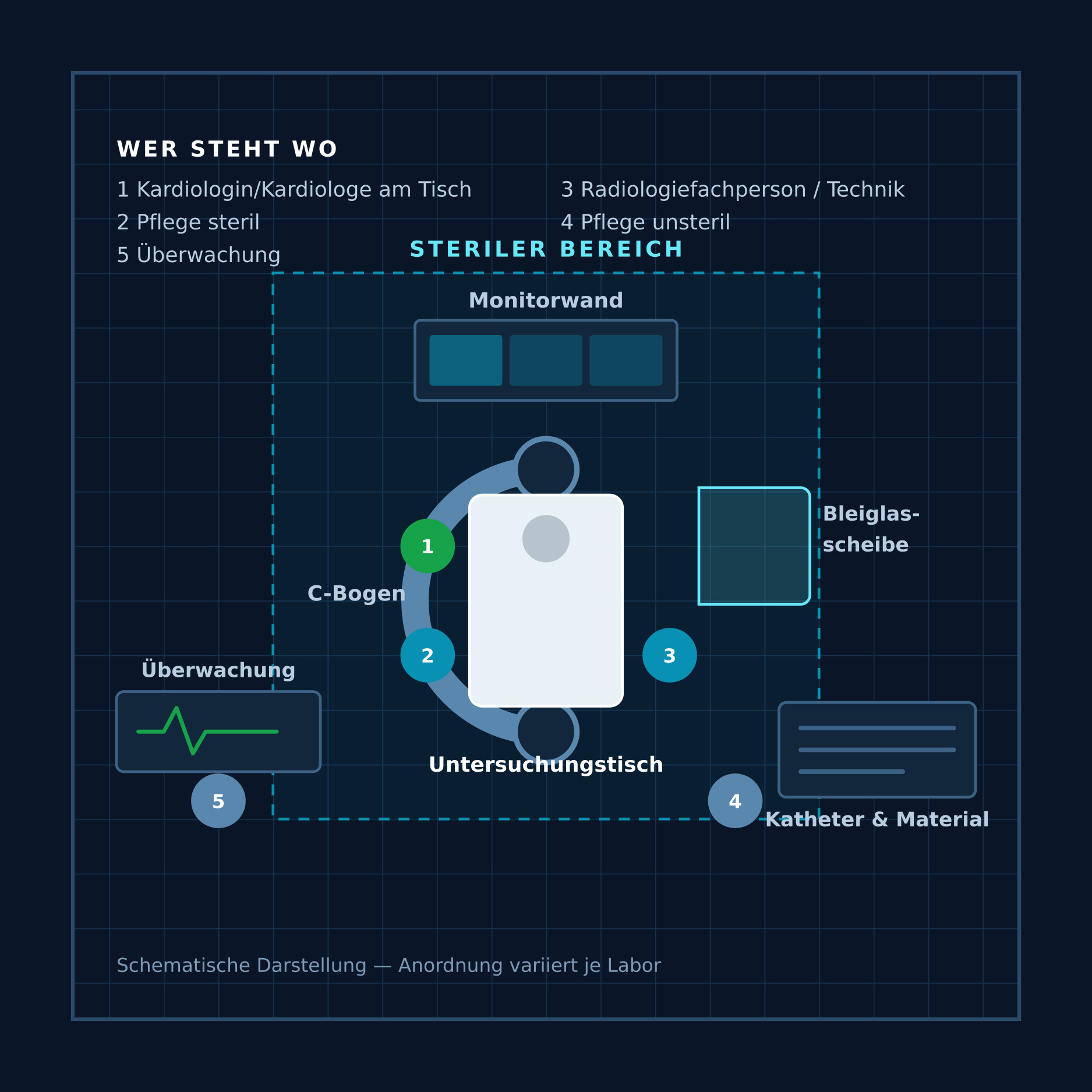
Everything in the room is designed around this process: the narrow, sliding table, the monitor booms suspended from the ceiling, the lead-glass screens behind which part of the team works, and the supply cabinets holding catheters and wires in every shape and size required.

How it differs from other rooms

  • Not the same as a cardiac surgery operating theatre — there the chest is opened; here the team works via an artery in the wrist
  • Not the same as a radiology department — there images are produced for assessment; here treatment can follow directly
  • Not the same as an examination room — sterile conditions apply, just as in an operating theatre
FMH
Medically reviewed

FMH-certified cardiologists · Cardiance Group · Last reviewed 2026-07

Schematic top view of a cardiac catheterisation laboratory

Schematic illustration. The actual layout differs from lab to lab.

02 — The team

Who works in the cardiac cath lab?

Usually four to five specialists with clearly defined roles. Feel free to ask who is responsible for what — the team will be happy to tell you.

01

Cardiologist

Stands at the table in sterile clothing, guides the catheters and wires, and makes the diagnostic and treatment decisions. During the procedure, the cardiologist is your main point of contact.

02

Radiographer / cardiac technologist

Operates the angiography system, positions the C-arm for each projection, controls image acquisition and monitors the radiation dose.

03

Sterile nurse

Hands over catheters, wires and balloons, prepares contrast agent and flushes, and maintains the sterile field.

04

Non-sterile nurse

Opens supplies, administers medication via the intravenous line, documents the procedure and takes care of positioning and keeping you covered.

05

Monitoring

Keeps a continuous eye on ECG, blood pressure, pulse and oxygen saturation and immediately reports any change to the table.

06

Anaesthesia on call

Not in the room for standard diagnostics, but available. Called in for longer interventions or when medically indicated.

03 — Equipment

What equipment is in the cardiac cath lab?

The following overview describes the equipment of modern cardiac catheterisation laboratories in general. We will be happy to clarify which additional procedures are available at which Cardiance site during your initial consultation.

The centrepiece. A U-shaped arm with an X-ray tube on one side and a detector on the other moves around the examination table and takes images from every angle required. Modern systems use pulsed fluoroscopy — radiation is emitted only in short pulses, which considerably reduces the dose.

Delivers the iodine-based contrast agent in precisely measured amounts and at a defined pressure. Precise dosing protects the kidneys and provides consistent image quality.

A wire with a pressure sensor at its tip measures how much the blood pressure drops beyond a narrowing. It answers the question an image alone cannot: does this narrowing actually restrict blood flow? More on this at koronarangiographie.ch.

Imaging from inside the vessel. Whereas angiography shows the inside of the vessel as a silhouette, IVUS and OCT show the vessel wall itself — plaque, calcification and the position of a stent. Used for complex findings and to check the result after stent implantation.

Balloons of various diameters and lengths for widening a narrowing. Stents are fine metal mesh tubes that keep the vessel open; drug-eluting versions release an active substance over several weeks that slows re-narrowing.

Continuous recording of ECG, arterial blood pressure, pulse and oxygen saturation. The traces run on a monitor that the whole team can see — changes are noticed within seconds.

A defibrillator, emergency medication and ventilation equipment are close at hand in the room. If temporary pacing is needed, a pacing lead can be introduced via the same access route.

Lead aprons and thyroid shields for the team, lowerable lead-glass screens above the table, dosimeters for the personal monitoring of every member of staff, and automatic dose logging for every procedure.

04 — Procedures

Which procedures are performed here?

Procedure Type What happens
Diagnostic
Imaging of the coronary arteries with contrast agent
Diagnostic
Additionally, pressure measurements inside the heart and assessment of the valves
Pressure wire measurement (FFR / iFR)
Diagnostic
Measures whether a narrowing significantly restricts blood flow
Balloon angioplasty (PTCA)
Therapeutic
Widening a narrowing with a balloon catheter
Stent implantation (PCI)
Therapeutic
Inserting a metal mesh that keeps the vessel open
Primary PCI for heart attack
Emergency
Immediate reopening of the blocked vessel
Catheter ablation
Therapeutic
Ablation of areas of heart muscle in rhythm disorders
Valve procedures (TAVI, MitraClip)
Therapeutic
Catheter-based valve replacement or valve repair

Not every cardiac catheterisation laboratory performs all procedures. Emergency care for acute heart attack, valve procedures and complex ablations require an intensive care unit and usually an in-house cardiac surgery department. The Cardiance Group specialises in planned diagnostics and interventional coronary treatment in an outpatient setting; for procedures requiring inpatient facilities, there are partnerships with partner hospitals.

05 — Safety

Safety standards and hygiene

Sterility

Radiation protection and monitoring

For context: in a purely diagnostic examination, serious complications occur in fewer than 1 in 1’000 cases (source: Swiss Society of Cardiology SSC, registry data 2025). You will find a detailed list of all risks at koronarangiographie.ch.

06 — From the patient's perspective

What you will experience in the cath lab

The process as it feels from the table — not as it reads in a medical report.

1

First impressions

Minute 0

A large, brightly lit room, usually noticeably cooler than a normal examination room. In the centre is a narrow table, above it the angiography system and several monitors on ceiling-mounted arms. The team wears disposable clothing and lead aprons. Most people find the room more technical than they expected — and calmer. If you feel cold, tell the team.

2

Positioning and introductions

5 min

You lie flat on your back and your arm is placed on a support. ECG electrodes and a blood pressure cuff are attached. You can find out at any time who in the room is responsible for what — just ask.

3

Draping and local anaesthetic

5 min

The puncture site is disinfected and the rest of your body is covered with sterile drapes — part of this drape runs above your face. You then receive a local anaesthetic at the puncture site, so the rest of the procedure is painless. You will see less, but you can hear and talk quite normally. Let the team know if this feels confining — the drape can usually be arranged differently.

4

The procedure

30–90 min

You will not feel the catheter — blood vessels have no pain receptors on the inside. What you will mainly notice is the C-arm moving and the sounds of the monitoring equipment; the team talks to one another throughout. When the contrast agent is injected, you may feel a brief sensation of warmth. You may be asked to breathe in briefly and hold your breath so that the images are sharp.

5

Finishing in the room

10 min

The sheath is removed and a pressure dressing is applied. The drapes are taken away and you can move again. You will often be told at this point what was seen; the definitive information is given in the results discussion that follows.

6

Back in the day-care bed

2–6 h

Monitoring in the day-care area and discussion of the results. If your readings are stable, you go home the same day accompanied by someone. You will find the full aftercare overview at herzkatheteruntersuchung.ch.

07 — Our labs

The two Cardiance cardiac catheterisation laboratories

Both sites operate their own cath lab, work to the same standard and are run by the same team of doctors.

Ergolz Klinik Liestal — Cardiance Group, Hammerstrasse 35

Ergolz Klinik Liestal

North-western Switzerland · Basel region · Baselland

Address

Hammerstrasse 35, 4410 Liestal

Getting here

8 min from Liestal station · Parking available

Consultation hours

Mon–Fri 08:00–18:00

Catchment area

Liestal · Sissach · Pratteln · Basel-Stadt · Oberbaselbiet

Cardiance Clinic Pfäffikon SZ — Zentrum Staldenbach

Cardiance Clinic Pfäffikon SZ

Central Switzerland · Lake Zurich · Canton of Schwyz (NOT Pfäffikon ZH)

Address

Zentrum Staldenbach 5/7, 8808 Pfäffikon SZ

Getting here

5 min from Pfäffikon SZ station · Underground car park

Consultation hours

Mon–Fri 08:00–17:00

Catchment area

Höfe · Ausserschwyz · Lake Zurich · March · Glarus · Linth region

08 — Cardiance at a glance

Switzerland's first outpatient heart clinic

95 %

Same-day discharge — patients go home on the same day

100 %

In the CSS Insurance quality report, Cardiance Clinic scored 100 % and was awarded the quality level “EXCELLENCE” (Pfäffikon site)

2500 +

Procedures per year — a volume standard for safety

48 h

First appointments available within 48 h

In the CSS Insurance quality report, Cardiance Clinic scored 100% and was awarded the quality level “EXCELLENCE”. This rating stands for outstanding medical quality and patient satisfaction.

09 — Our team

FMH cardiologists with cath lab experience

The same doctors at both sites — consistent points of contact from the initial assessment through to aftercare.

Prof. Dr. med. Ahmed A. Khattab — Medical Director, Cardiance Group
Medical Director

Prof. Dr. med. Ahmed A. Khattab

FMH Cardiology · Invasive Cardiology · Interventional Cardiology

Prof. Dr. med. et phil. nat. Rolf Vogel — Head of Cardiology (Liestal), Cardiance Group
Head of Cardiology (Liestal)

Prof. Dr. med. et phil. nat. Rolf Vogel

FMH Cardiology · Interventional Cardiology · Dipl. Ing. ETH

Prof. Dr. med. Dai-Do Do — Angiology (Pfäffikon), Cardiance Group
Angiology (Pfäffikon)

Prof. Dr. med. Dai-Do Do

FMH Angiology · Interventional Angiology · Duplex ultrasound

Prof. Dr. med. Karl-Heinz Kuck — Electrophysiology, Cardiance Group
Electrophysiology

Prof. Dr. med. Karl-Heinz Kuck

FMH Cardiology · Electrophysiology · Heart rhythm disorders

Full medical team at cardiance.com/arzte

10 — FAQ

Frequently asked questions

Answers curated by our FMH-certified cardiologists. Can’t find your question? Simply give us a call.

A cardiac catheterisation laboratory (cath lab) is a dedicated procedure room in which the coronary arteries are visualised and treated under X-ray fluoroscopy. At its heart is an angiography system with a movable C-arm that delivers real-time images of the heart. The room operates under operating-theatre conditions: sterile, air-conditioned and with full monitoring of heart rhythm, blood pressure and oxygen saturation.

Usually four to five people: the cardiologist performing the procedure at the table, a radiographer or cardiac technologist operating the system, one or two nurses handling equipment and medication, and one person at the monitoring console. You can ask at any time who is responsible for what.

No, a general anaesthetic is not needed for a diagnostic cardiac catheterisation. You receive a local anaesthetic at the puncture site and stay awake and able to talk. A mild sedative is available on request. Being awake has an advantage: you can tell the team at any time if something feels uncomfortable.

The room temperature is deliberately kept low because the equipment gives off heat and the air conditioning also has to maintain air purity. In addition, the team works in sterile gowns and heavy lead aprons. Tell the team if you feel cold — blankets are available.

The most noticeable are the C-arm moving around the table, the regular beeping of the ECG monitor and the team talking to one another. None of these is an alarm signal. If a sound changes, the team will explain what it means.

Diagnostic: coronary angiography, pressure measurements inside the heart and pressure wire measurement (FFR or iFR). Therapeutic: balloon angioplasty and stent implantation, together known as percutaneous coronary intervention (PCI). Larger centres also perform valve procedures such as TAVI and catheter ablation for heart rhythm disorders there.

For patients, the dose of a diagnostic examination is typically in the range of a few millisieverts; for comparison, natural background radiation in Switzerland is around 5 to 6 millisieverts per year. Fluoroscopy only runs while images are actually needed. The team wears lead aprons and works behind radiation shields, and the dose of every procedure is documented.

Operating-theatre conditions apply. The team performs surgical hand disinfection and wears a sterile gown or disposable clothing, gloves and a mask. The puncture site is disinfected and the rest of the body is covered with sterile drapes. All catheters, wires and sheaths are sterile-packed single-use products.

The lab is designed for this. A defibrillator, emergency medication and ventilation equipment are in the room, and the team is trained in emergency procedures. The most common incidents, such as brief heart rhythm disturbances or circulatory reactions, can be treated within seconds. For situations requiring an intensive care unit or cardiac surgery, there are partnerships with partner hospitals.

Two — one each at the Ergolz Klinik in Liestal BL and the Cardiance Clinic Pfäffikon SZ. Both work to the same standard and are run by the same team of doctors. More than 95 per cent of diagnostic procedures are performed as outpatient procedures, with discharge on the same day.

First appointments available within 48 hours

Questions about the procedure? Talk to us beforehand

Many worries disappear in a ten-minute preliminary conversation. Our patient administration team will get back to you within one working day and, if needed, arrange a conversation with the doctor who will perform the procedure.

Mon–Fri · 08:00–18:00 (Pfäffikon SZ until 17:00)

Emergencies outside opening hours: 144 (ambulance)

Herzkatheterlabor.ch – Cardiance Group
Seraphinite AcceleratorOptimized by Seraphinite Accelerator
Turns on site high speed to be attractive for people and search engines.